
Prioritize field review with season-long context.
AP Intelligence helps insurance and risk teams maintain a continuing field record, compare reported events with recent weather and field changes, and give adjusters better context before they travel.
What AP Intelligence does not decide
AP Intelligence supports claim triage, field review, and documentation. It does not determine coverage, cause of loss, liability, fraud, or indemnity. Final claim decisions remain with the insurer and its authorized adjusters.
How claims and risk teams use AP Intelligence
Six steps, from the season-long baseline to the portfolio view. Each one supports human review; none replaces it.
- Build the baseline
Understand the field before a reported event.
Maintain a consistent record of available field conditions, crop development, weather context, and prior observations across the season.
- Organize reported events
Bring the claim and field context together.
Review reported fields alongside recent weather, field-condition changes, boundaries, crop information, and available field history.
- Prioritize human review
Identify where a closer look may be needed.
Help claims teams organize field review and decide where adjuster time may be most valuable.
- Prepare the adjuster
Arrive with better field context.
Give the adjuster field boundaries, recent observations, weather context, available signal history, and prior documentation before the visit.
- Preserve field documentation
Keep observations with the field record.
Organize notes, photographs, observations, event context, and follow-up items around the same field.
Availability Notes, photographs, and observation workflows are labeled Upcoming until they ship.
- Review the portfolio
See field review across the portfolio.
Help claims and risk teams organize fields by geography, crop, reported event, review status, or other supported portfolio dimensions.
Availability Grouping by geography, crop, and field status is available today; event and review-status dimensions are scoped per program and labeled in the product as they become available.
Real AP Intelligence interfaces, not a claims system
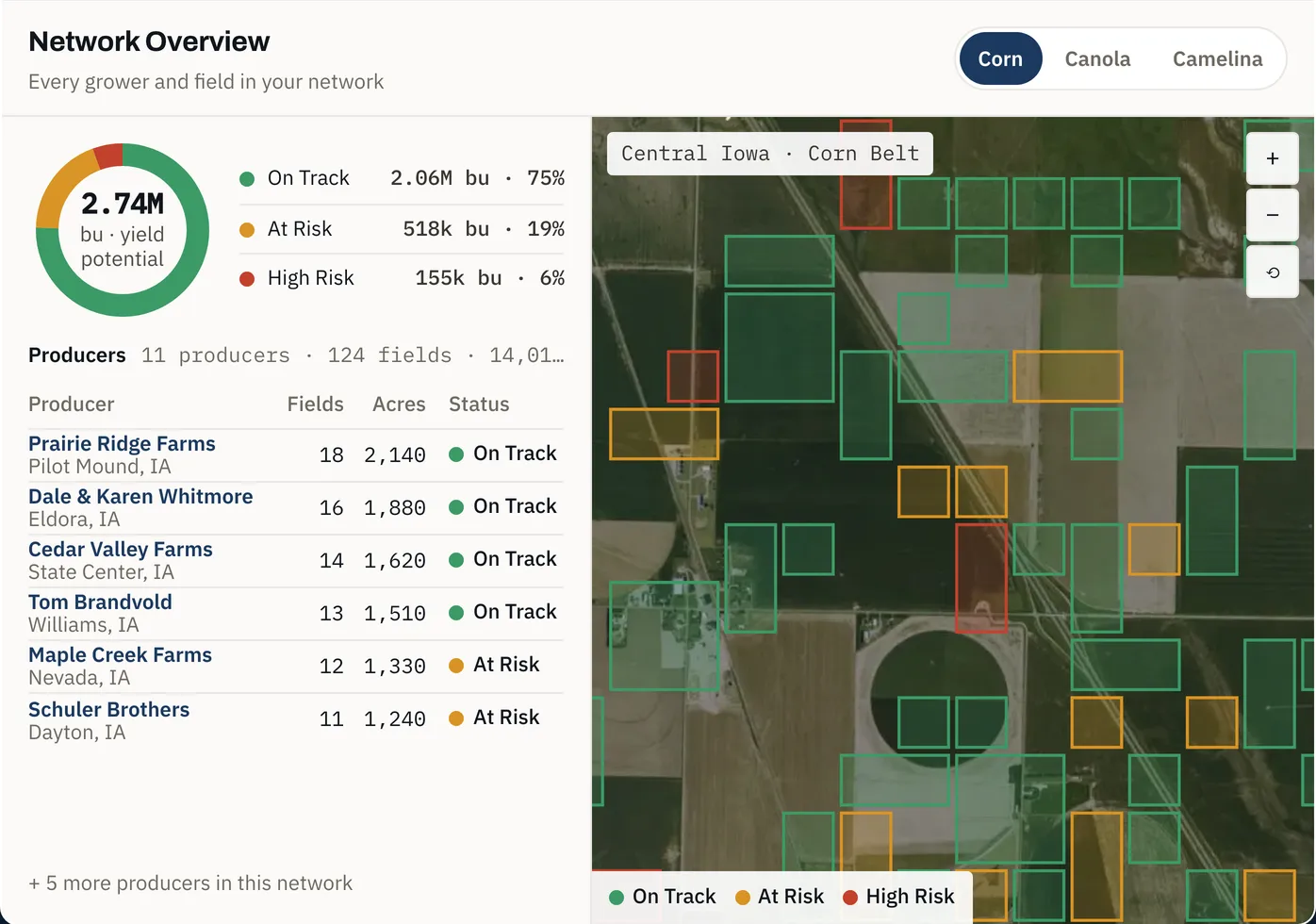
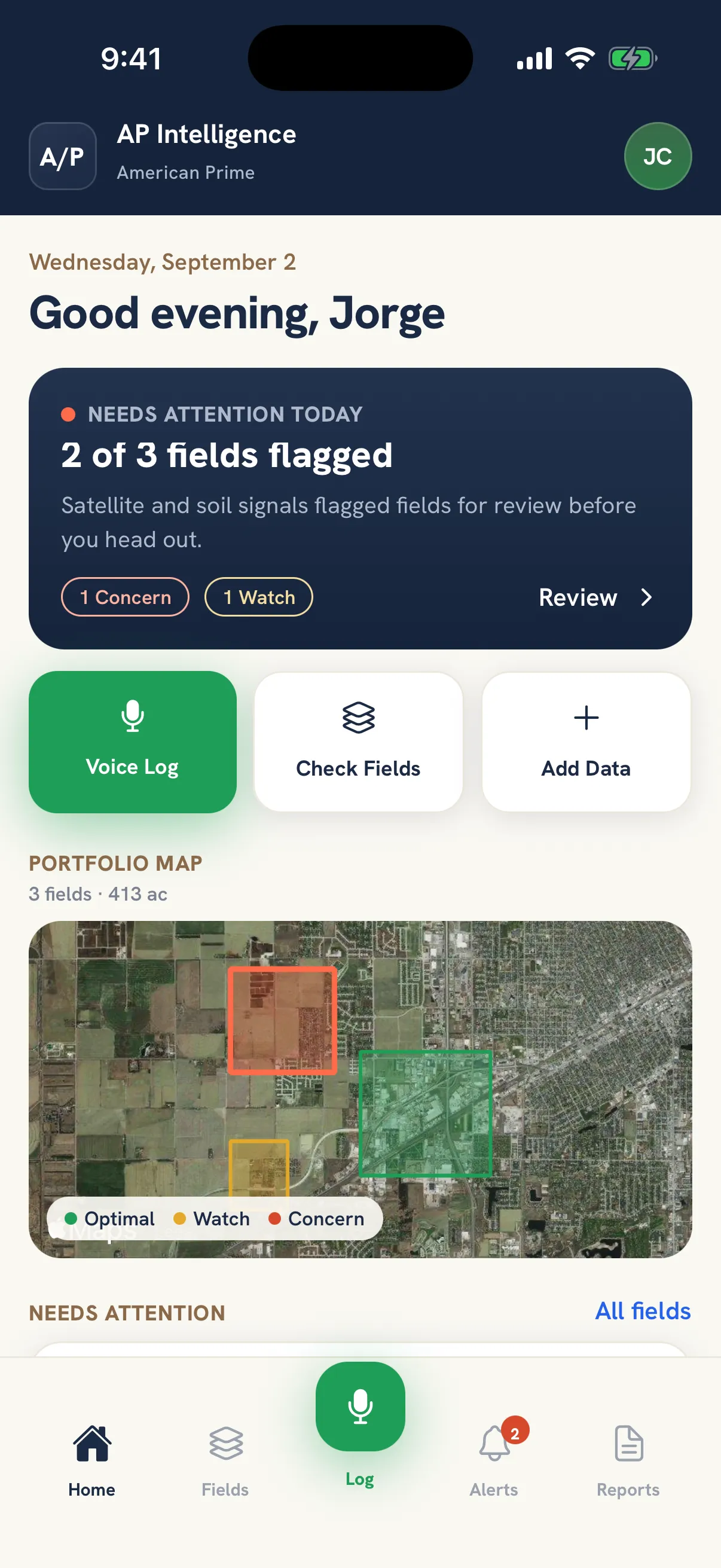
These are the screens a claims or risk team works from today, shown with illustrative field data. There is no adjuster dashboard, loss score, or damage classification, and none is shown here.
 AP Intelligence Portfolio · Network Overview Season 2026
  AP Intelligence Portfolio · Field priorities
 Fields ranked for review
34 fields- North Quarter, Concern, Recent vegetation change, Updated 2 d ago
- Creek Bottom 12, Watch, Moisture context, Updated 1 d ago
- East 40, Watch, Recent weather context, Updated today
- 31 additional fields in the portfolio.
What determines pricing?
This use case is priced through AP Intelligence organization pricing (Basic, Pro, or Enterprise), configured to the program. There is no separate price list.
Basic covers portfolio monitoring for the internal claims team; Pro adds grower participation; Enterprise covers integrations, custom reporting, and implementation.
Organizational pricing depends on how the team works and the data configuration required.
See Organization Pricing- Portfolio scale
- Historical depth
- Spatial detail
- Monitoring requirements
- Users
- Reporting
- APIs
- System integration
- Data migration
- Specialized implementation
Plans are priced by fields, context, collaboration, and organization scale. There are no credits, usage meters, or industry-specific surcharges.
What we ask when scoping an insurance program
There is no public calculator. A short conversation sets the configuration: portfolio scale, historical depth, spatial detail, monitoring requirements, users, reporting, and integration needs.
Discuss an Insurance Pilot- Organization
- Role
- Geographic coverage
- Primary crops
- Approximate insured acres
- Approximate fields or policy units
- Historical years required
- Typical event types
- Standard or enhanced field detail
- Adjuster or user count
- Reporting requirements
- Data export or integration needs
- Anything else we should know
Straight answers
No. It organizes field context, history, and documentation so the insurer’s adjusters can decide. Coverage, cause of loss, liability, fraud, and indemnity stay with the insurer.
No. Fields are updated as new satellite, weather, and field information becomes available; satellite revisit and cloud cover set the cadence. It is season-long context, not a live feed.
Plans are chosen by how the team works. Basic covers portfolio monitoring for an internal team; Enterprise applies when a program needs integrations, custom reporting, or implementation work. Pilots are scoped per program.
Start with one book of insured acreage.
Tell us the geography, the crops, and the field context your claims team needs before a visit. We scope a pilot around a real portfolio.
Discuss an Insurance Pilot