
Know which fields need you first.
Monitor fields continuously, compare conditions across your operation, and focus scouting where the strongest signals appear. Built for farmers, agronomists, and agribusiness supply-chain teams.
 AP Intelligence · Dashboard Season 2026
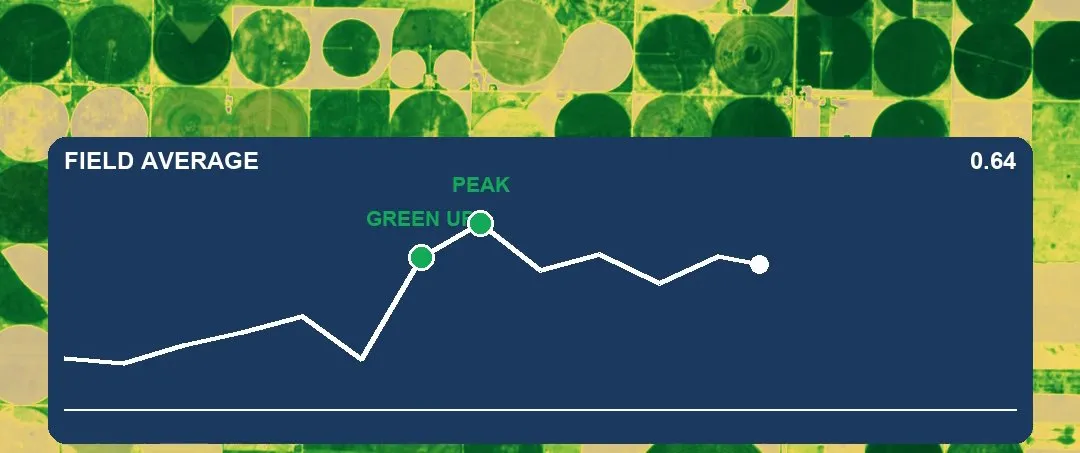
Product preview using illustrative field data.
What best describes your operation?
You cannot walk every acre every week. You do not have to.
Most fields go unseen between visits. AP Intelligence keeps watch in between, comparing each field against its own history and its neighbors and flagging the ones that deserve a closer look.
From portfolio to field detail in two clicks.
 AP Intelligence Farm · Field: North Quarter Alerts
Moisture signal is strongest near the drainage. Compare against the 2025 season before deciding on irrigation.
Planned and actual crop by season, kept with the field.
Product preview using illustrative field data.
The same priorities, on your phone.
Real screens from the AP Intelligence iOS app: the daily dashboard, scouting priorities, field vegetation, and weather risk.
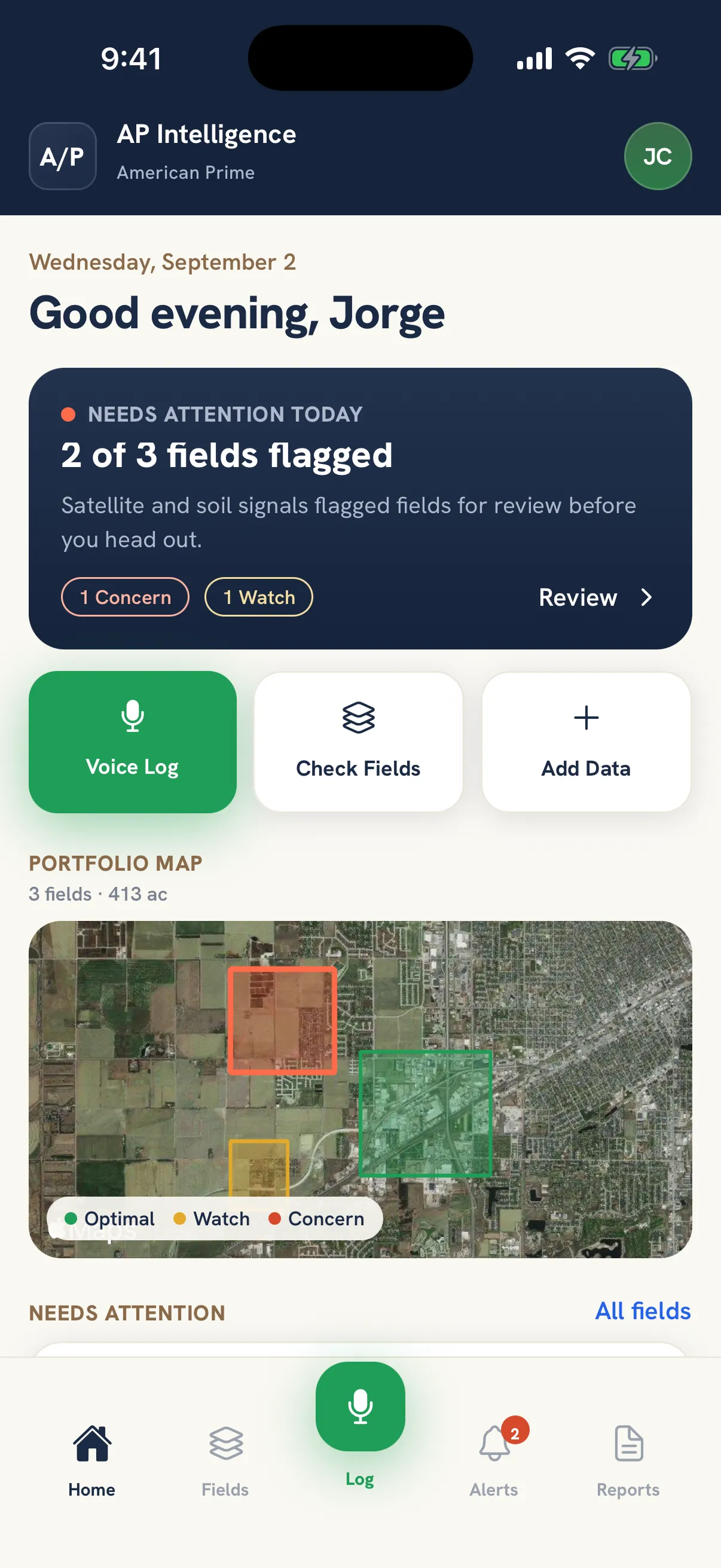
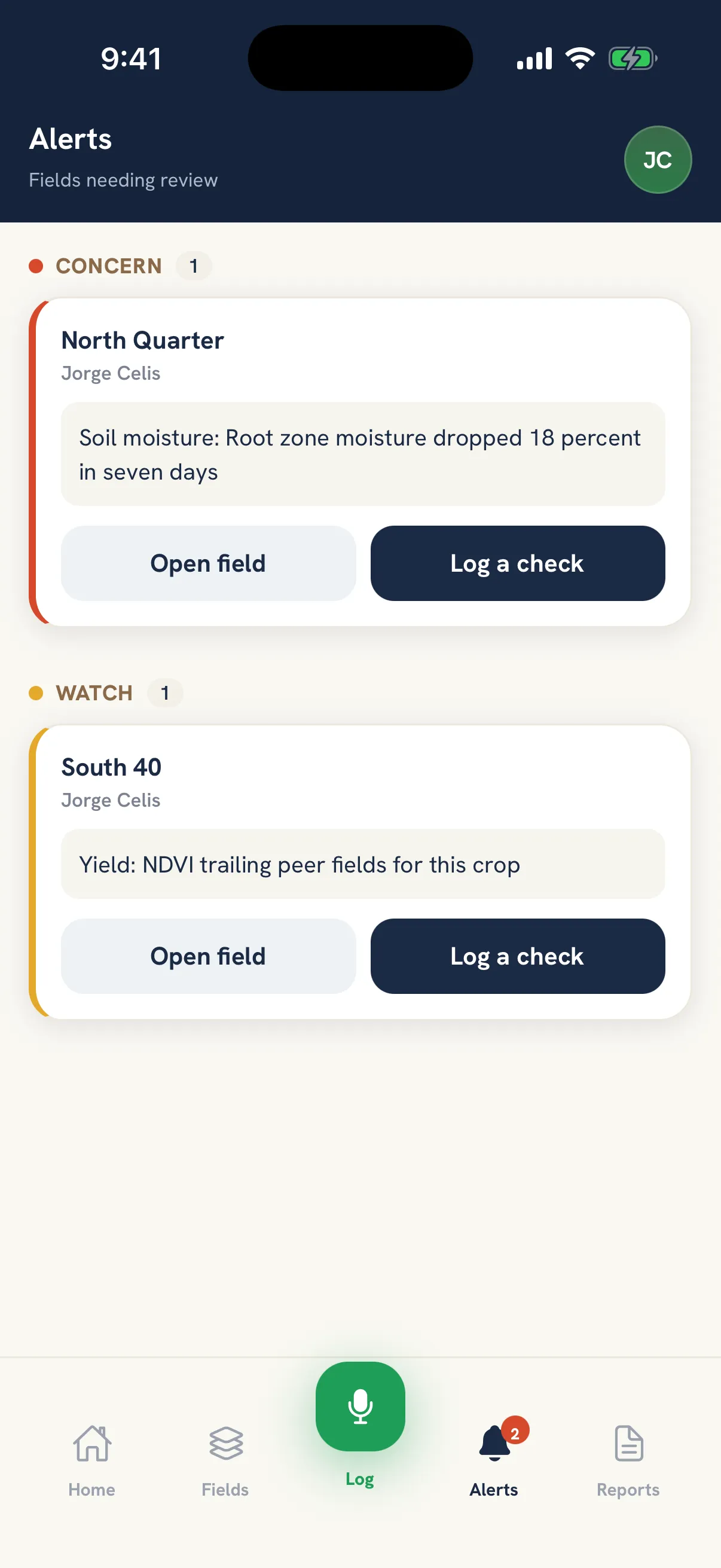
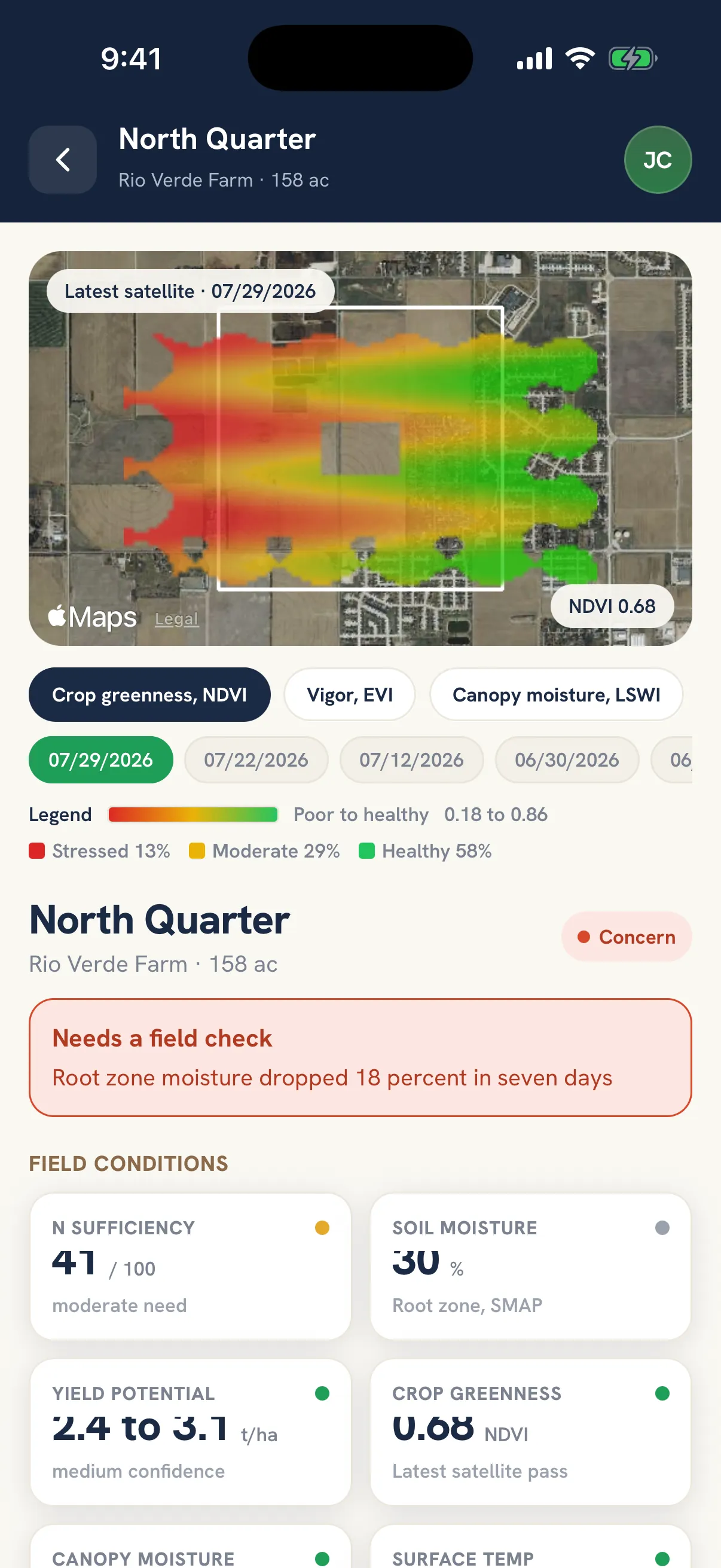
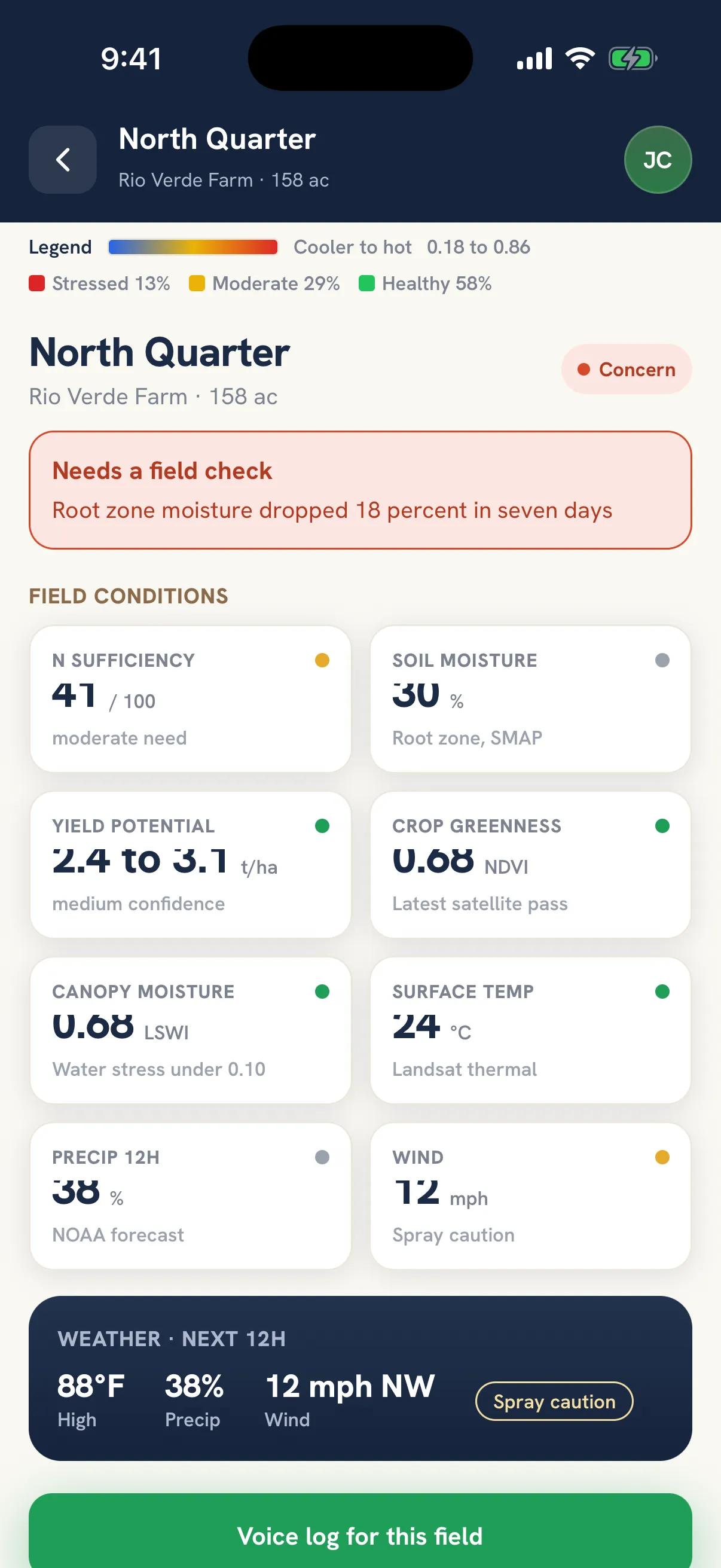
Captures from the current early-access build. Field names are demo fields.
Organized around decisions, not data layers.
Know where to look
- Field prioritization across your whole operation
- Portfolio view with concern, watch, and OK statuses
- Fields flagged when a signal crosses a threshold
- Field-to-field comparison within a season
Understand what changed
- Satellite and weather context for every signal
- Soil moisture and rainfall context behind every flag
- Season history: planned and actual crop by year
- Target vs. actual yield records, by season
Coordinate the next step
- Scouting priorities you can hand to a team
- Producer and organization accounts with shared farms
- Field notes and recordkeeping Upcoming
- Connection to AP Drone Hub missions Upcoming
AP Intelligence flags signals and priorities. It does not diagnose crop problems or replace field verification by you or your agronomist.
What AP Intelligence covers for your crop.
Two things are true for every crop. Field monitoring does not depend on what you plant: satellite condition, weather and soil-moisture context, scouting priorities, and season history run on every registered field. Crop-specific intelligence is interpretation tuned to one crop. It ships crop by crop, and the product labels it per field, so what you see in the app always matches this list.
Vegetation condition and variability, weather and environmental context, official weather alerts, Concern and Watch priorities, and your field’s season history. Works the day you outline a field.
Risk rules, seasonal interpretation, and analytics tuned to one crop. Each capability is labeled by crop below and inside the product, and moves up only when our validation supports it.
Service geography: fields in the United States. Satellite revisit and cloud cover set the update cadence; the platform always shows the age of each signal. Crop not listed? Ask about your crop. Monitoring works today, and your request shapes what we build next.
- Field monitoring & season history Included
- Weather & environmental context Included
- Scouting priorities (Concern / Watch) Included
- Crop-aware weather risk Included Freeze risk interpretation
- Seasonal development interpretation In development
- Crop classification & acreage mapping Analytics engagement
- Yield-related analysis In development
Crop-aware weather risk for corn is live: freeze exposure is interpreted against corn-specific thresholds. Seasonal interpretation and yield-related outputs arrive labeled in the product as validation supports them.
- Field monitoring & season history Included
- Weather & environmental context Included
- Scouting priorities (Concern / Watch) Included
- Crop-aware weather risk Included Freeze risk interpretation
- Seasonal development interpretation In development
- Crop classification & acreage mapping Analytics engagement
- Yield-related analysis In development
Crop-aware weather risk for soybeans is live: freeze exposure is interpreted against soybean-specific thresholds. Seasonal interpretation and yield-related outputs arrive labeled in the product as validation supports them.
- Field monitoring & season history Included
- Weather & environmental context Included
- Scouting priorities (Concern / Watch) Included
- Crop-aware weather risk In development
- Seasonal development interpretation In development
- Crop classification & acreage mapping Analytics engagement
- Yield-related analysis In development
Canola fields get complete monitoring today. Oilseed-specific interpretation and indices are in development and arrive through the early-access period, labeled in the product.
- Field monitoring & season history Included
- Weather & environmental context Included
- Scouting priorities (Concern / Watch) Included
- Crop-aware weather risk In development
- Seasonal development interpretation In development
- Crop classification & acreage mapping Analytics engagement
- Yield-related analysis In development
Sunflower fields get complete monitoring today. Oilseed-specific interpretation and indices are in development, labeled in the product as they become available.
- Field monitoring & season history Included
- Weather & environmental context Included
- Scouting priorities (Concern / Watch) Included
- Crop-aware weather risk In development
- Seasonal development interpretation In development
- Crop classification & acreage mapping In development
- Yield-related analysis In development
Camelina fields get complete monitoring today. Camelina-specific interpretation is in development as part of the oilseed program.
- Field monitoring & season history Included
- Weather & environmental context Included
- Scouting priorities (Concern / Watch) Included
- Crop-aware weather risk In development
- Seasonal development interpretation In development
- Crop classification & acreage mapping Analytics engagement
- Yield-related analysis In development
Spring wheat fields get complete monitoring today. Wheat is handled as two crops, spring and winter, because their seasons and risks differ.
- Field monitoring & season history Included
- Weather & environmental context Included
- Scouting priorities (Concern / Watch) Included
- Crop-aware weather risk In development Freeze rule in review (OK, KS, TX)
- Seasonal development interpretation In development
- Crop classification & acreage mapping Analytics engagement Historical records
- Yield-related analysis In development
Winter wheat fields get complete monitoring today. Wheat is handled as two crops, spring and winter, because their seasons and risks differ.
- Field monitoring & season history Included
- Weather & environmental context Included
- Scouting priorities (Concern / Watch) Included
- Crop-aware weather risk Not yet
- Seasonal development interpretation Not yet
- Crop classification & acreage mapping Analytics engagement Historical records
- Yield-related analysis Not yet
Outline the field, record the crop, and monitoring starts: condition, weather, priorities, and history. Tell us the crop and region and we will say plainly what is available now and what is planned.
From sign-up to season, in six steps.
Outline field areas in the app under your farm or organization.
Satellite, weather, and environmental signals accumulate per field.
The dashboard ranks fields with concern and watch statuses.
Go verify in the field, starting where signals are strongest.
Record target and actual yield per season.
Each season's history sharpens next season's context.
What early access includes
- The full AP Intelligence platform at no cost through the official launch in November 2026
- New capabilities arriving throughout early access
- Producer accounts for farms; corporate accounts for organizations and their teams
- An optional walkthrough with our team to set up your fields
- A direct line to the people building the product
Create your account, outline your fields, and start monitoring. If you would like help getting set up, request a walkthrough.
Sign Up for Early Access Request a Walkthrough See plans and pricing after launch →Frequently asked questions
What do I need to get started?
A name and email. Create a producer account for a farm or a corporate account for an organization, then outline your fields in the app. No hardware, no sensors, no installation.
How are fields added?
Add an area on the map for each field. Fields belong to a farm, and organizations can manage several farms. Season and crop history can be added as you go.
How often does the information update?
Signals update as new satellite passes and weather data arrive. Frequency varies with data source, cloud cover, and season; the platform shows the age of each signal so you always know how fresh it is.
Does AP Intelligence diagnose crop problems?
No. It flags fields and areas that may need attention and gives you the context to investigate. Diagnosis and treatment decisions stay with you and your agronomist.
Which crops does AP Intelligence support?
Every crop gets full field monitoring: satellite condition, weather context, official weather alerts, scouting priorities, and season history. Crop-specific intelligence ships crop by crop. Today corn and soybeans have crop-aware risk interpretation, and canola, sunflowers, camelina, and both wheats are in development. If you grow something else, monitoring still works today, and the product labels crop-specific layers per field as they arrive.
Who owns the data?
You do. American Prime is built on the principle that producers keep control and ownership of the data generated from their fields.
What does it cost?
Early access is free through the official launch in November 2026. After launch, AP Intelligence has Free, Pro, and Premium plans for farms and Organization Basic, Pro, and Enterprise for portfolios, starting at $0 per month with unlimited field registration on every plan, and you choose your plan at launch. As an Early Access Benefit, accounts created before launch get Organization features at no cost for the first three months after launch.