
(Authored by the American Prime team, with insights from Dr. Jeff Basara)
For U.S. corn and soybean producers, this growing season is becoming a new story not only about yield, but about timing. Across several major producing regions, crops initially moved toward maturity faster than their typical seasonal pace, but that early acceleration has not translated into a consistently faster harvesting. As the season progressed, harvest activity slowed and, in some cases, fell behind historical averages, highlighting how increasingly variable weather conditions can disrupt traditional crops and harvest timelines.
The latest USDA Crop Progress report (released on October 5) provides a striking snapshot of how the 2026 harvest is progressing. As of October 5, 83% of U.S. corn had reached maturity, in line with the five-year average and up from 72% the previous week. Meanwhile, 23% of the crop was harvested, still trailing the five-year average of 27%.
Meanwhile, harvest is progressing across the country, although the national pace is now slightly behind the historical average. The USDA reported 23% of the U.S. corn crop harvested, compared with the five-year average of 27%. Progress varies significantly by state: Kansas had harvested 54% of its corn, compared with a five-year average of 53%; Missouri was at 50% versus 49%; Kentucky at 69% versus 57%; and Tennessee at 83% versus 68%.
Soybeans are showing a noticeable shift as harvest moves deeper into the season. As of October 5, 85% of U.S. soybeans were dropping leaves, up from 75% one week earlier but slightly behind the five-year average of 87%. Soybean harvest reached 25% nationally, up from 17% the previous week but trailing the five-year average of 33%.
The latest figures suggest that harvest progress has slowed relative to the historical pace in several important production areas, particularly across parts of the Midwest and western Corn Belt. This marks a change from earlier in the season, when soybean development was generally running ahead of normal. Crop conditions have also softened as the season has progressed. As of October 5, USDA rated 54% of the U.S. corn crop good or excellent, down three percentage points from the previous week. Soybeans were rated 57% good or excellent, down one point from the previous week.
Taken together, the latest USDA data point to a different late-season picture than earlier reports suggested: crop development is largely nearing completion, but harvest progress is now lagging the historical pace, while condition ratings for both corn and soybeans have weakened as the season moves toward completion.
Weather is changing the crop calendar
The U.S. crop calendar is changing during the Fall as warmer temperatures, variable rainfall, and shifting harvest dates alter when fields can be planted and prepared. Currently, the USDA’s September Crop Production report describes an unusually hot summer across much of the country. August marked the second consecutive month in which unusually hot conditions dominated large parts of the United States, while hotter- and drier-than-normal weather across the southern Plains and Mississippi Delta reduced soil moisture and increased crop stress.
Conditions across the Corn Belt were more complex. While temperatures moderated across parts of the Midwest during August, moisture remained highly uneven. Flooding affected portions of the lower Midwest while drought persisted across parts of the northern and western Corn Belt.
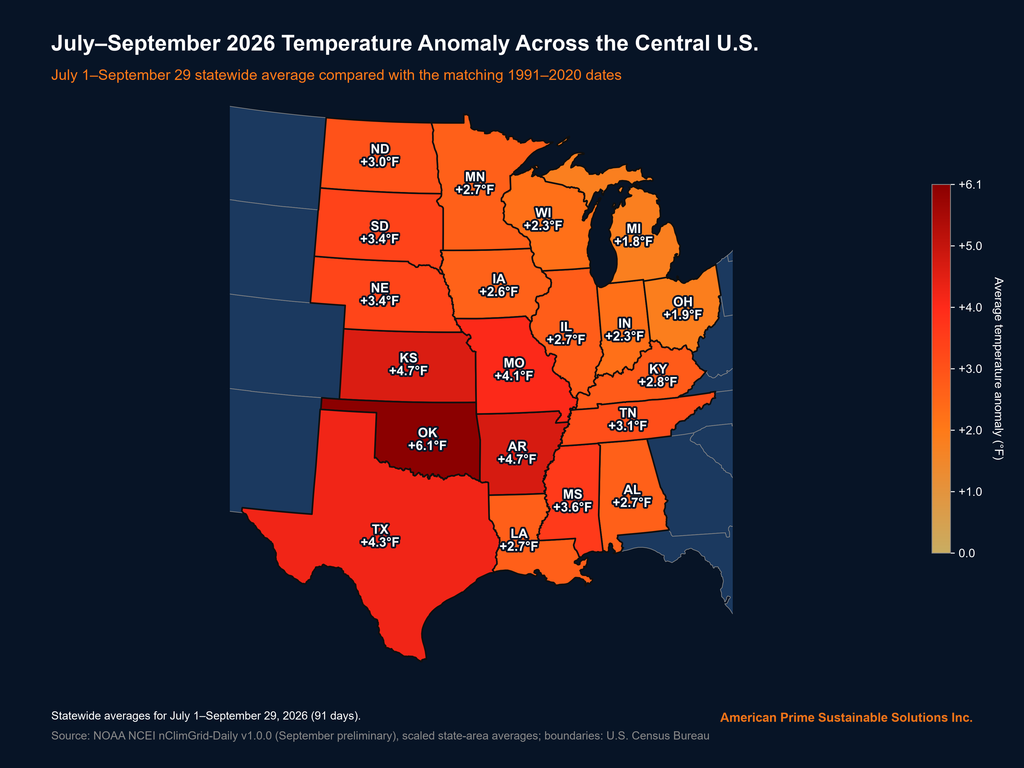
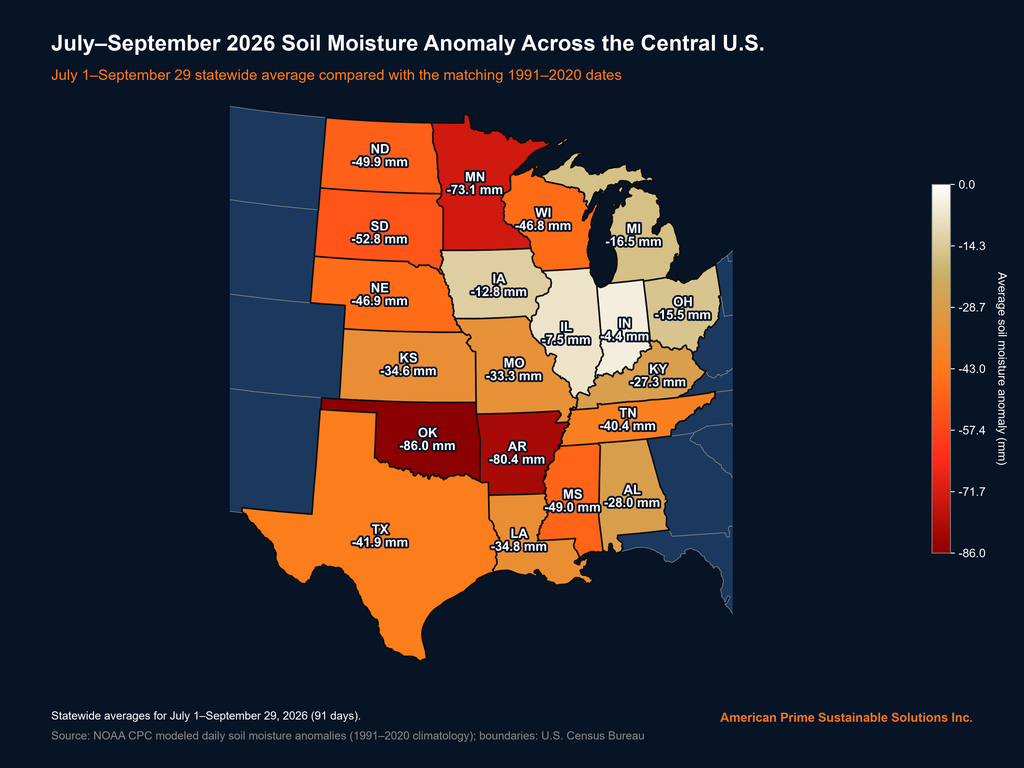
USDA specifically noted that mid- to late-summer drought and heat earlier in the growing season caused crops in the Upper Midwest to mature quickly. For example, 68% of the corn in Minnesota had already reached the dent stage compared with a five-year average of 43% by late August. In North Dakota, corn development and soybean leaf drop were also running well ahead of normal. These developments follow an earlier signal from the 2026 wheat season, where weather conditions also affected crop development and harvest timing across parts of the country.
The pattern raises a larger question for U.S. agriculture: what happens when the calendar farmers have historically used to plan crop development, scouting and harvest becomes less predictable? For producers, an earlier harvest is not simply a scheduling issue. Changes in crop maturity can affect field scouting, harvest sequencing, machinery and labor availability, grain moisture and drying decisions, storage planning, and ultimately when individual fields should be harvested. And national or even state-level averages can only tell part of that story. A crop may be progressing ahead of normal nationally while individual fields only miles apart experience very different conditions because of rainfall, soil moisture, temperature, crop health and localized weather events.
Why field-level intelligence becomes increasingly important.
Tools such as the American Prime Intelligence Platform, combining satellite observations, localized weather data and AI-driven agricultural intelligence, can help producers monitor conditions at the individual-field level rather than relying solely on historical calendars or broad regional averages.
Even when statewide data indicate warmer and drier conditions, differences in soil type, topography, planting date and crop development can cause individual fields to respond differently. This field-level perspective can help producers compare conditions across their operation, focus scouting efforts and assess whether harvest timing should be adjusted. As weather variability continues to challenge traditional assumptions about the growing season, knowing what is happening in a specific field, at a specific moment, may become increasingly important for making better-informed harvest decisions.
Sources
- USDA National Agricultural Statistics Service (NASS). Crop Progress — October, 5, 2026.
https://esmis.nal.usda.gov/publication/crop-progress - USDA National Agricultural Statistics Service (NASS). Crop Progress & Condition Charts — 2026.
https://www.nass.usda.gov/Charts_and_Maps/Crop_Progress_%26_Condition/ - USDA National Agricultural Statistics Service (NASS). National Crop Progress — 2026 Reports.
https://data.nass.usda.gov/Publications/National_Crop_Progress/ - USDA / NOAA. Weekly Weather and Crop Bulletin — October 2026.
https://esmis.nal.usda.gov/publication/weekly-weather-and-crop-bulletin - USDA NASS. Crop Progress and Condition — Survey and Data Methodology.
https://www.nass.usda.gov/Surveys/Guide_to_NASS_Surveys/Crop_Progress_and_Condition/